
J-1 Visa Guide: Requirements and Benefits of the Research Scholar Category

Choosing the right J-1 category can feel like navigating a maze of bureaucracy. If you’re a recent graduate looking to gain professional experience in the U.S., you’ve likely encountered two main paths: the J-1 Trainee and the J-1 Research Scholar.
While the "Trainee" title sounds like a natural fit for someone entering the workforce (and is often the best option depending on your circumstances), the Research Scholar category often offers superior flexibility and longevity.
Here is why the Research Scholar visa might be the better choice for your career.

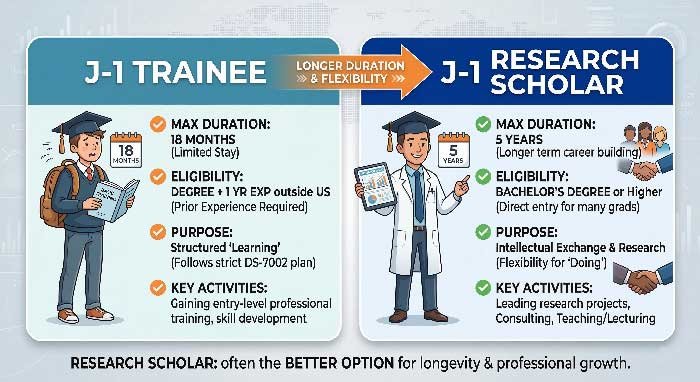
1. The Clock: 18 Months vs. 5 Years
The most immediate advantage is the duration of stay.
J-1 Trainee: This is capped at 18 months. For most, this feels like a "sprint"—by the time you’ve settled into your role and expanded your network, it’s already time to pack your bags.
J-1 Research Scholar: This category allows you to stay for up to 5 years. This gives you the breathing room to lead long-term projects, build deep professional relationships, and potentially bridge the gap until you qualify for other visas like the H-1B or O-1.
2. Eligibility "Hurdles" are Actually Easier
The J-1 Trainee visa has a strict "prior experience" requirement that can be a catch-22 for recent graduates. To qualify as a Trainee, you generally need a degree plus one year of work experience outside the U.S. (or five years of experience if you don't have a degree).
In contrast, the Research Scholar category typically only requires a Bachelor’s degree (or higher) in a relevant field. If you’ve just finished your Master's or PhD, you can often jump straight into a Research Scholar role without needing that extra year of "home country" experience required by the Trainee route.
3. Flexibility in Activity
While the Trainee visa is bound by a very rigid DS-7002 Training Plan, the Research Scholar category is designed for higher-level intellectual exchange.
Trainees: Must follow a phased training plan that focuses on "learning" rather than "doing" a standard job.
Research Scholars: Can conduct research, engage in projects, consult, and even teach or lecture. This makes you more valuable to your host institution because you can contribute to the organization's mission more broadly.
Important Nuances to Consider
Before you decide, there are two "bars" you need to know about:
The 24-Month Bar: If you complete a J-1 Research Scholar program, you cannot return to the U.S. as a Research Scholar or Professor for two years. (This is different from the 212(e) Home Residency Requirement, though you might be subject to both).
The 12-Month Bar: If you have been in the U.S. in any J status for more than six months, you may have to wait 12 months before beginning a Research Scholar program.
Compare Programmes
| Feature | J-1 Trainee | J-1 Research Scholar |
|---|---|---|
| Max Duration | 18 Months | 5 Years |
| Experience Req. | Degree + 1 year exp. | Degree only (usually) |
| Primary Focus | Structured learning | Research & Collaboration |
| Plan Required | Strict DS-7002 | Flexible Research Goal |
Need Help or advice? Get in touch with our team.
Just send us an email at info@istplus.com, outlining your current situation and your proposed job in the USA (attaching a CV/resume and an outline of the position is always helpful).
We’ll take a look and come back to you with an overview of the best options available!